
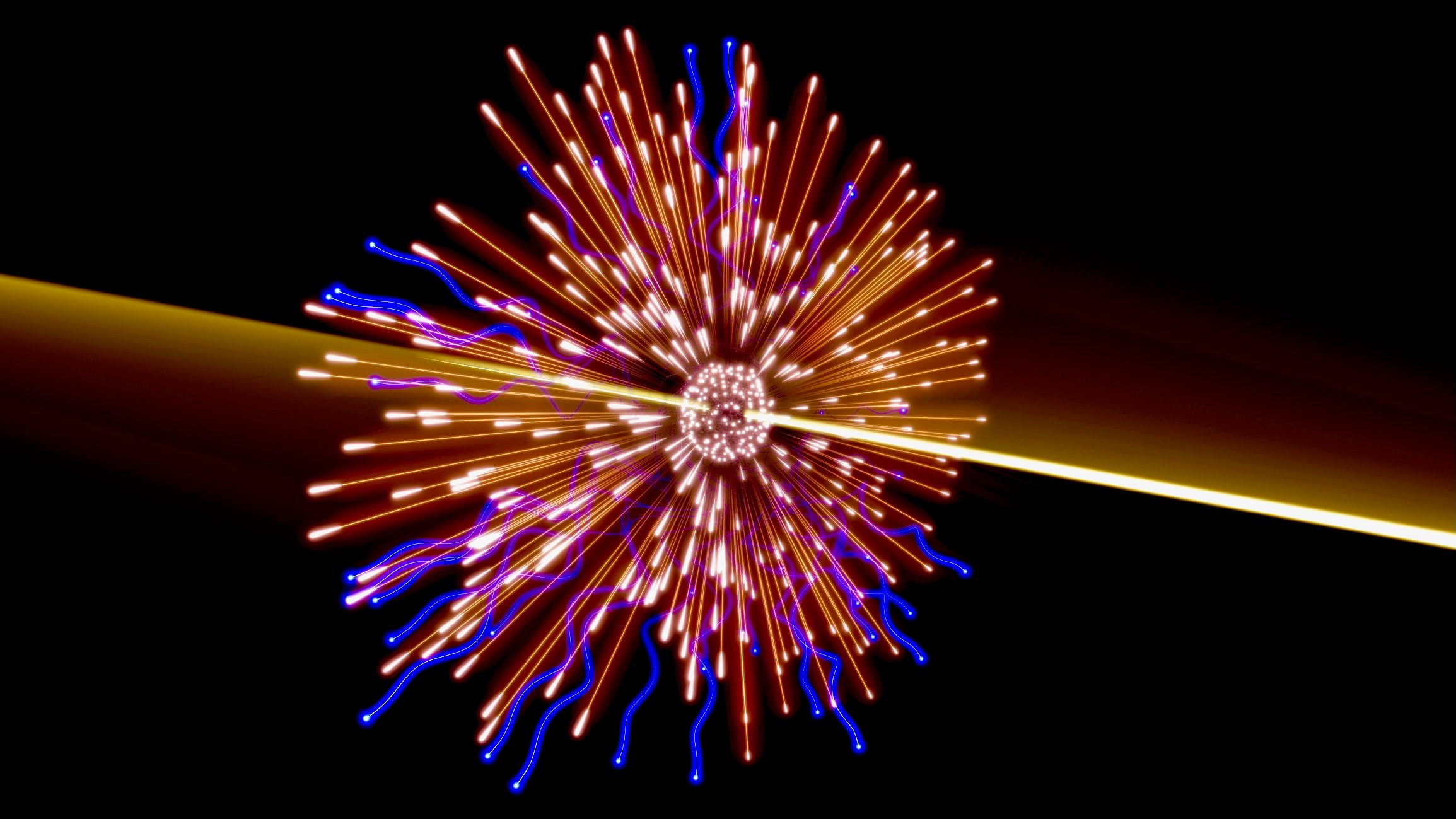
After a search lasting more than four decades, a UK-led team of physicists have found evidence for the rarest decay of a subatomic ‘beauty’ particle ever seen. The results could open the door to a strange new world known as the zeptoverse, where particles that could help explain mysteries like dark matter and how matter came into existence during the Big Bang may be hiding.
The team, working at the upgraded LHCb experiment at CERN’s Large Hadron Collider (LHC) near Geneva, were studying beauty quarks, exotic cousins of the up and down quarks that make up all atomic matter in the universe.
When these beauty particles are created, they live for just one and a half trillionths of a second before they decay. The way they decay can tell us about physics that happens at very short-distance scales: trillionths of billionths of a metre.
“What we found in these latest results is an incredibly rare decay of one of these beauty particles, where it turns into two even smaller particles called muons,” said Dr Harry Cliff from the University of Cambridge’s Cavendish Laboratory, who led the analysis team. “This process only happens for one in every ten billion beauty particles, so it’s incredibly difficult to find.”
This is the first time that evidence for this rare type of decay, known as ‘Bd to mu mu’, has been achieved by a single experiment. The results, which have not yet been peer-reviewed, will be presented today (3 November) at CERN.
Related posts:
 The Solar System by Hubble
 Space Streams IRC Chat
 NASA Progresses Toward Artemis II Moon Mission
 Hubble Seeks Clusters in ‘Lost Galaxy’
 Space Chat Podcast
 European Space Agency (ESA)
 Artemis II
 Gemini North telescope
 3I/ATLAS
 How to disable XP participation on YouTube chat
 Space Streams – Observing Earth [Ambient] Live Stream
 Andromeda Galaxy
 Space Streams – Nebula [Ambient] YouTube Live Stream
 Into the storm
 Quantum Physics
 Space Physics
 NGC 6334, The Cat’s Paw Nebula
 A 340-million pixel starscape from Paranal
 Rosette Nebula: The Heart of a Rose
 NASA Releases Hubble Image Taken in New Pointing Mode
 A supermassive black hole dwells at the center of this galaxy
 A Virgo cluster galaxy
 Get involved
 NGC 1672
 M74
 Christmas Tree Galaxy Cluster
 Star cluster IC 348
 NGC 604
 Top of the Horsehead Nebula
 Serpens Nebula
 Chandra telescope star cluster insight
 Chandra telescope: A pair of colliding spiral galaxies
 PIA03606: Most Detailed Image of the Crab Nebula
 WFC3 visible image of the Carina Nebula
 Westerlund 2 – Hubble’s 25th anniversary image
 Mystic Mountain in Infrared
 Mystic mountains visible light
 The Milky Way
 Gallery