

As 2026 nears, NASA continues moving forward to launching and flying Artemis II, the first crewed mission under the Artemis campaign, no later than April next year.
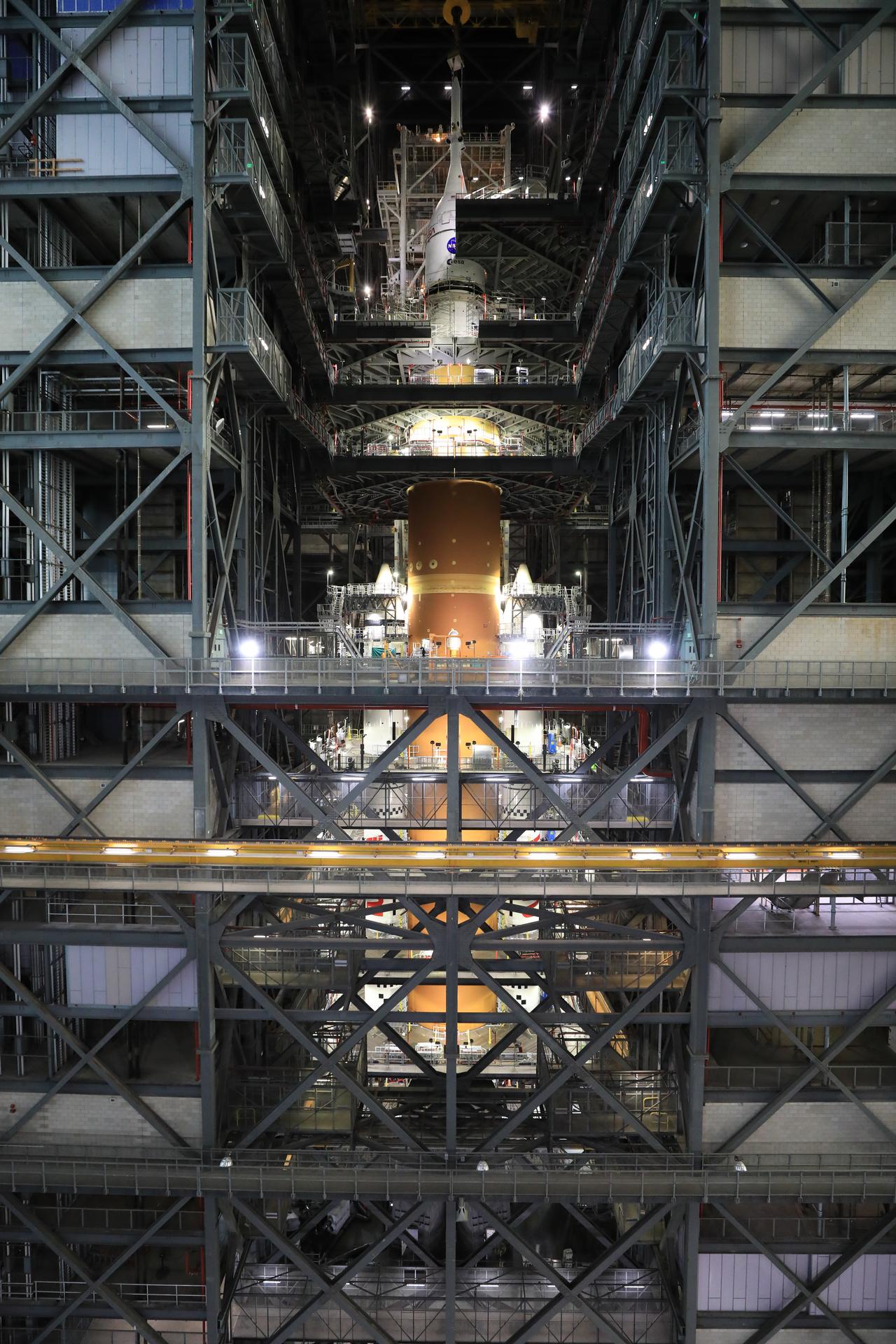
NASA’s Orion spacecraft, complete with its launch abort system escape tower, is now integrated with the SLS (Space Launch System) rocket in the Vehicle Assembly Building (VAB) at the agency’s Kennedy Space Centre in Florida. Following Orion stacking, teams completed testing critical communications systems between SLS and Orion, and confirmed the interfaces function properly between the rocket, Orion, and the ground systems, including end-to-end testing with the Near Space Network and Deep Space Network, which aid in communications and navigation.
“NASA remains focused on getting ready to safely fly four astronauts around the Moon and back,” said acting NASA Administrator Sean Duffy. “Our mission will lay the groundwork for future missions to the lunar surface and to Mars.”
In the coming weeks, engineers and the Artemis II crew will conduct the first part of a Countdown Demonstration Test at Kennedy, a dress rehearsal for launch day. The crew will don their Orion crew survival system spacesuits and venture to their rocket before being secured inside Orion, which the crew recently named Integrity, simulating the final moments of the countdown. Because the rocket and spacecraft are not yet at the launch pad, the crew will board Orion inside the VAB. The test will serve as a final verification of the timeline for the crew and supporting teams on the ground. A second part of the test, preparing for an emergency at the launch pad, will occur after the rocket and spacecraft roll out to Launch Pad 39B.
The Artemis II crew and ground personnel responsible for launching and flying the mission are preparing to conduct additional integrated simulations across teams and facilities to prepare for any scenario that could arise as the crew of four launches from Florida and flies their approximately 10-day mission.
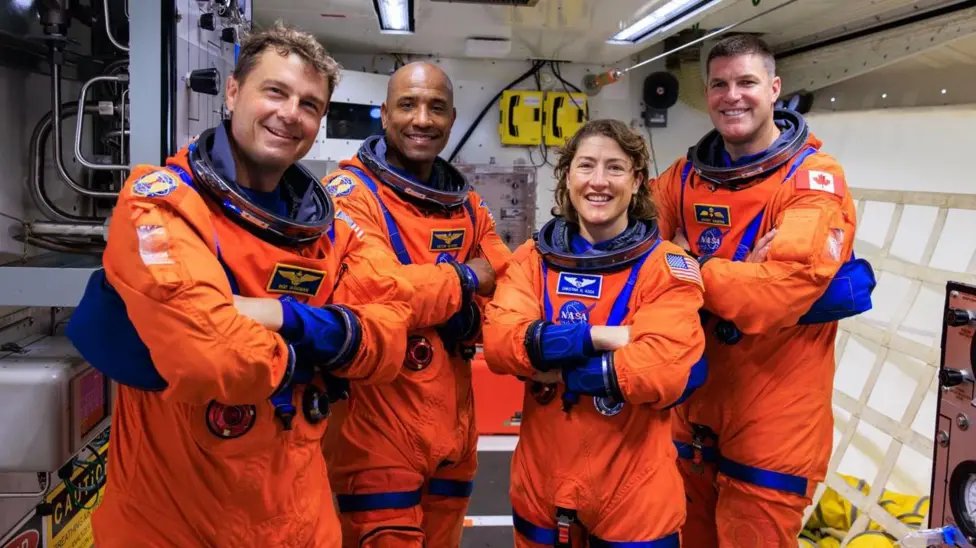
NASA astronauts Reid Wiseman, Victor Glover, and Christina Koch, and CSA (Canadian Space Agency) astronaut Jeremy Hansen, have a busy schedule over the next several months reviewing procedures for all phases of flight until their preparations are second nature, practicing for different mission scenarios, and maintaining their familiarity with every element of their spacecraft.
Through Artemis, NASA will send astronauts to explore the Moon for scientific discovery, economic benefits, and build the foundation for the first crewed missions to Mars.
Nasa’s mega rocket has been moved to the launch pad in Cape Canaveral, Florida, as the final preparations get underway for the first crewed mission to the Moon in more than 50 years.
Over almost 12 hours, the 98m-tall Space Launch System was carried vertically from the Vehicle Assembly Building on the 4-mile (6.5km) journey to the pad.
Now it is in position, the final tests, checks – and a dress rehearsal – will take place, before the go-ahead is given for the 10-day Artemis II mission that will see four astronauts travel around the Moon.
Nasa says the earliest the rocket can blast off is 6 February, but there are also more launch windows later that month, as well as in March and April.
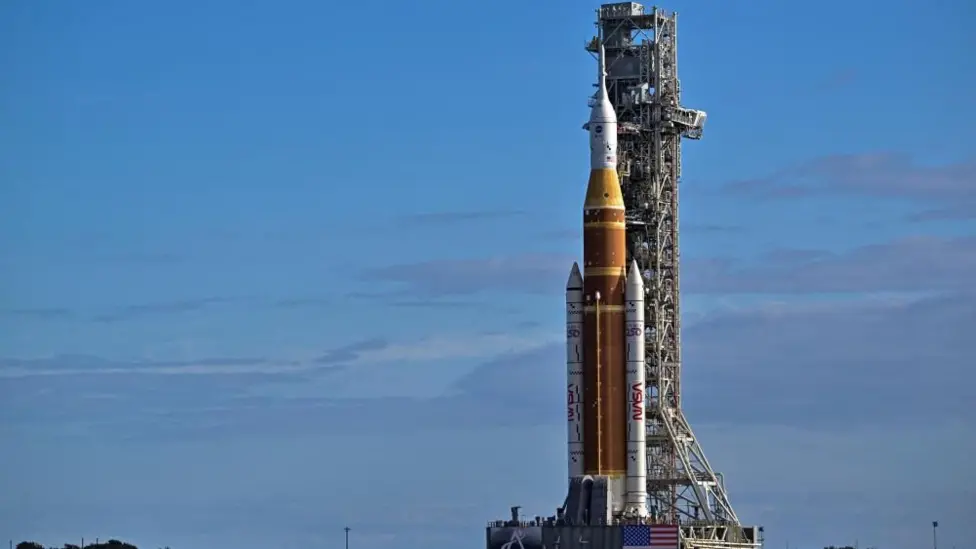
The rocket began moving at 07:04 local time (12:04 GMT) and arrived at Launch Pad 39B at the Kennedy Space Centre at 18:41 local time (23:42 GMT).
The rocket was carried by a huge machine called a crawler-transporter, travelling at a top speed of 0.82 mph (1.3 km/h) as it trundled along. Live coverage captured the slow-moving spectacle.
Nasa said the rocket will be prepared over the next few days for what it calls a “wet dress rehearsal” – a test for fuel operations and countdown procedures.
The Artemis II crew – Nasa’s Reid Wiseman, Victor Glover and Christina Koch and Canadian astronaut Jeremy Hansen – were at the Kennedy Space Centre watching the rocket as it was moved.
In just a few weeks, the four astronauts will be strapped into a spacecraft, perched on the top of the rocket, ready to blast off to the Moon.
It will be the first crewed mission to the Moon since Apollo 17 landed on its surface in December 1972.
Nasa said the mission could take its astronauts further into space that anyone has been before.
Artemis II is not scheduled to land on the Moon, but will instead lay the groundwork for a future lunar landing led by the Artemis III mission.
Nasa said the launch of Artemis III will take place “no earlier than” 2027. But, experts believe 2028 is the earliest possible date.
Koch said it was an amazing feeling to see the rocket.
“Astronauts are the calmest people on launch day. And I think… it feels that way because we’re just so ready to fulfil the mission that we came here to do, that we’ve trained to do,” she said.
Hansen said he hoped the mission would inspire the world.
“The Moon is something that I’ve taken for granted. I’ve looked at it my whole life, but then you just glance at it and glance away,” he said.
“But now I’ve been staring at it a lot more, and I think others will be joining us and staring at the Moon a lot more as there will be humans flying around the far side and that is just good for humanity.”
Before Artemis II heads to the Moon, the first two days of their mission will be spent in orbit around the Earth.
“We’re going to be going into an orbit almost right away that is 40,000 miles out – like a fifth of the way of the Moon,” Koch told BBC News.
“We will have the Earth out the window as a single ball, something none of us have seen in that perspective.
“And then we’re going to travel a quarter of a million miles away… we’re going to do a lot of science and operations along the way.”
While they fly around the far side of the Moon, the crew will have three hours dedicated to lunar observation – to gaze, take images and to study its geology, which will help plan and prepare for a future landing at the Moon’s south pole.
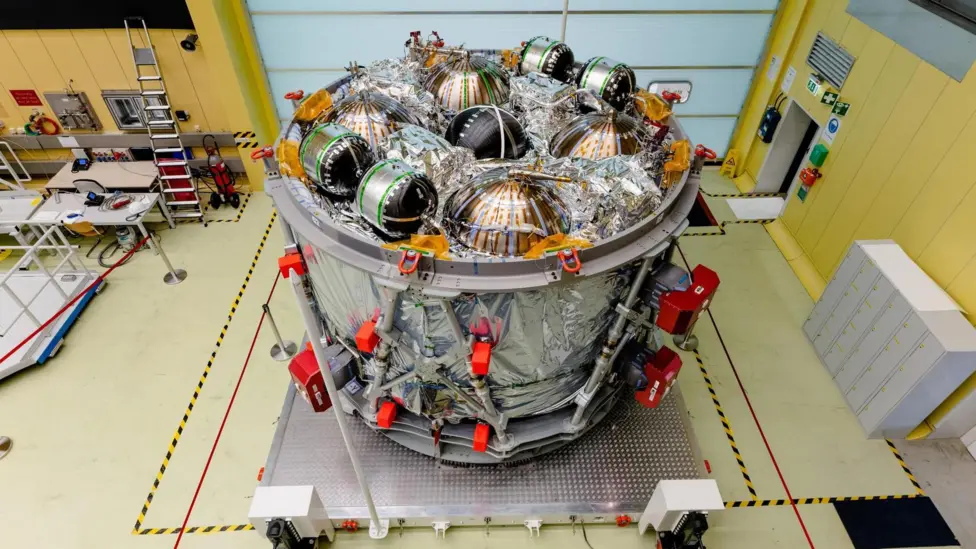
A key part of the Orion spacecraft that the astronauts will be flying in was made in Bremen in Germany.
The European Service Module, which sits behind the crew capsule, is the European Space Agency’s contribution to the mission and has been built by Airbus.
“The European Service Module is so important – we basically can’t get to the Moon without it,” says Sian Cleaver, a spacecraft engineer at Airbus.
“It provides the propulsion that Orion needs to get us to the Moon.”
Its large solar arrays will generate all the electrical power for the craft, she adds.
“We’ve also got these big tanks full of oxygen and nitrogen, which are mixed to make air, and also water, so that we can provide everything that the astronauts need in the crew module to keep them alive on their journey.”
Credits: NASA/Kim Shiflett and BBC
Related posts:
 Space Chat Podcast Topics
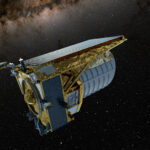 Euclid wide-angle space telescope
 Hubble Seeks Clusters in ‘Lost Galaxy’
 Space Chat Podcast
![International Space Station (ISS) Camera's Capture Views Of Hurricane Matthew [Unedited] YT image](https://space-streams.com/wp-content/uploads/2025/10/space-station-storm-mathew-yt-150x150.png) International Space Station (ISS) Camera’s Capture Views Of Hurricane Matthew YouTube Live Stream
International Space Station (ISS) Camera’s Capture Views Of Hurricane Matthew YouTube Live Stream
 Space Streams Documentaries YouTube Live Stream
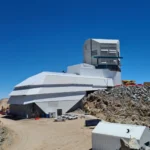 Vera Rubin Telescope
 European Space Agency (ESA)
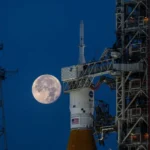 Artemis II
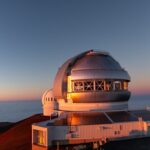 Gemini North telescope
 3I/ATLAS
 How to disable XP participation on YouTube chat
 Space Streams – Documentaries + Space Chat
 International Space Station (ISS) Camera’s Capture Views Of Hurricane Matthew [Unedited] Live Stream
 Space Streams – Observing Earth [Ambient] Live Stream
![Space Streams - Nebula [Ambient] image](https://space-streams.com/wp-content/uploads/2024/11/space-streams-nebula-150x150.png) Space Streams – Nebula [Ambient] YouTube Live Stream
Space Streams – Nebula [Ambient] YouTube Live Stream
 Cassiopeia A
 NASA Unburies Danger Zones of Star Cluster
 The icy blue wings of Hen 2-437
 Into the storm
 Quantum Physics
 NGC 6334, The Cat’s Paw Nebula
 A rare radio galaxy
 Swirling blue arms shimmer in this galaxy
 A rosy barred spiral galaxy
 In this galaxy, colours tell a story
 A supermassive black hole dwells at the center of this galaxy
 A Virgo cluster galaxy
 Portrait of a Globular Cluster
 Get involved
 NGC 1672
 M74
M74
 Christmas Tree Galaxy Cluster
 Cassiopeia A (NIRCam)
 Top of the Horsehead Nebula
 NGC 4151: An Active Black Hole in the “Eye of Sauron”
 Chandra telescope star cluster insight
 Chandra telescope: A pair of colliding spiral galaxies
 PIA03606: Most Detailed Image of the Crab Nebula
 NGC 6960: The Witch’s Broom Nebula
 Hubble view of Messier 106
 Westerlund 2 – Hubble’s 25th anniversary image
 Mystic Mountain in Infrared
 Mystic mountains visible light
 The Milky Way
 Posts
Posts
 New website launched
 Chandra X-ray Observatory
 Welcome to Space Streams
 Space Streams
