The Nancy Grace Roman Space Telescope (formerly WFIRST) is NASA’s premier next-generation wide-field infrared observatory. Operating from the Sun-Earth Lagrange point 2 (L2), Roman is engineered to map the cosmos at unprecedented speeds, complementing the narrow-field depth of the James Webb Space Telescope (JWST) and the ultraviolet-visible imaging of the Hubble Space Telescope.
Core Specifications & Optical Design
Roman pairs a Hubble-sized primary mirror with an optical layout optimized for massive structural field coverage.
| Parameter | Specification |
| Primary Mirror Diameter | 2.4 meters (7.9 feet) |
| Field of View | 0.281 deg², over 100 times larger than Hubble’s near-IR view |
| Optical Design | Three-mirror anastigmat telescope |
| Wavelength Range | 0.48 to 2.3 micrometers (visible to near-infrared) |
| Orbit | Halo orbit around Sun-Earth L2 |
| Design Lifetime | 5-year primary mission (10-year goal) |
| Data Volume | ~11 Terabits downlinked per day |
Scientific Instrumentation
Roman carries two main instruments integrated into its payload carrier:
1. Wide Field Instrument (WFI)
-
Detector Array: 300.8-megapixel focal plane array consisting of 18 Teledyne HgCdTe (Mercury-Cadmium-Telluride) detectors (4096 × 4096 pixels each).
-
Capabilities: 8 broad-band imaging filters, a slitless high-dispersion grism, and a low-dispersion prism for multi-object spectroscopy.
-
Function: Serves as the primary survey engine, capturing vast swaths of the sky with Hubble-like resolution (0.11 arcseconds per pixel) in fractions of the time.
2. Coronagraph Instrument (CGI)
-
Technology Demonstration: A high-contrast imaging system designed to perform direct imaging of exoplanets and circumstellar disks.
-
Key Optics: Features advanced starlight-suppression masks combined with active wavefront control (two deformable mirrors driven by thousands of actuators).
-
Performance: Capable of dimming a central star’s light by a factor of 100 million to 1 billion, allowing direct detection of Gas Giants and sub-Neptune planets in visible light.
Primary Science Objectives
-
Dark Energy & Cosmic Acceleration: By mapping billions of faint galaxies across cosmic time, Roman will measure weak gravitational lensing, baryon acoustic oscillations, and redshift-space distortions to test General Relativity and evaluate dark energy models.
-
Exoplanet Microlensing Survey: By monitoring tens of millions of stars in the inner Milky Way bulge, Roman will detect planetary systems via gravitational microlensing. This technique is sensitive to exoplanets far from their host stars—including sub-Earth mass bodies and rogue planets wandering without a star.
-
Core Community Surveys: Roman will execute open-access legacy sky surveys, assembling massive deep-field datasets to explore galaxy evolution, black hole demographics, and local structure.
Related posts:
 The Solar System by Hubble
 The Hubble Space Telescope’s best images of the planets and other celestial bodies of our Solar System
 The Hubble Space Telescope’s best images of the planets and other celestial bodies of our Solar System
 Euclid wide-angle space telescope
 YouTube Channel Artwork
New YouTube Channel Updates
YouTube Channel Artwork
New YouTube Channel Updates
 How Open NASA Data on Comet 3I/ATLAS Will Power Tomorrow’s Discoveries
 Space Streams IRC Chat
 NASA Progresses Toward Artemis II Moon Mission
 Hubble Seeks Clusters in ‘Lost Galaxy’
 Space Chat Podcast
 Space Streams Documentaries YouTube Live Stream
 Vera Rubin Telescope
 European Space Agency (ESA)
 Artemis II
 Gemini North telescope
 3I/ATLAS
 How to disable XP participation on YouTube chat
 Kepler Space Telescope
 Space Streams – Observing Earth [Ambient] Live Stream
 Andromeda Galaxy
![Space Streams - Nebula [Ambient] image](https://space-streams.com/wp-content/uploads/2024/11/space-streams-nebula-150x150.png) Space Streams – Nebula [Ambient] YouTube Live Stream
Space Streams – Nebula [Ambient] YouTube Live Stream
 Schumann resonances
 NGC 3627
 Cassiopeia A
 NASA Unburies Danger Zones of Star Cluster
 The icy blue wings of Hen 2-437
 Into the storm
 Hubble image of Kleinmann-Low Nebula
 Space Chat
 Space Physics
 NGC 6334, The Cat’s Paw Nebula
 A rare radio galaxy
 A 340-million pixel starscape from Paranal
 Sombrero Galaxy M104
 Rosette Nebula: The Heart of a Rose
 NASA Releases Hubble Image Taken in New Pointing Mode
 Swirling blue arms shimmer in this galaxy
 A rosy barred spiral galaxy
 In this galaxy, colours tell a story
 A supermassive black hole dwells at the center of this galaxy
 A Virgo cluster galaxy
 Portrait of a Globular Cluster
 Get involved
 NGC 346
 NGC 1672
 M74
M74
 The Eagle Nebula
 Christmas Tree Galaxy Cluster
 Cassiopeia A (NIRCam)
 Star cluster IC 348
 NGC 604
 Top of the Horsehead Nebula
 Serpens Nebula
 NGC 4151: An Active Black Hole in the “Eye of Sauron”
 Chandra telescope star cluster insight
 Chandra telescope: A pair of colliding spiral galaxies
 Hubble Tangos with a Dancer in Dorado
 PIA15985: Hubble Captures View of ‘Mystic Mountain’
 PIA03606: Most Detailed Image of the Crab Nebula
 NGC 6960: The Witch’s Broom Nebula
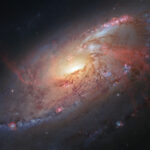 Hubble view of Messier 106
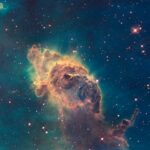 WFC3 visible image of the Carina Nebula
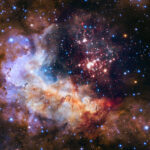 Westerlund 2 – Hubble’s 25th anniversary image
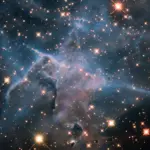 Mystic Mountain in Infrared
 Mystic mountains visible light
 The mystery of the interstellar medium
 The Milky Way
 Pleiades
 Horsehead Nebula
 Posts
Posts
 James Webb Space Telescope
 Hubble Space Telescope
 Chandra X-ray Observatory
 Gallery
 Contact us
 Space Streams
 Privacy Policy